
The optimal sample rate at which to record is a matter of considerable debate. Proponents of recording at sample rates above 44.1 KHz typically claim that the higher frequencies yield greater detail. And while there's a tradeoff - tracks recorded at 96 KHz need more than twice the storage space of those captured at 44 KHz - we're assured that the increased detail means listeners hear more accurate recordings.
Don't believe it. In recorded sound, accuracy is a myth.
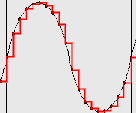
Sample rate refers to the regularity with which a digital recording system checks its input for sound. Systems that sample more often can capture higher frequencies. An engineer named Harry Nyquist figured out the head-spinning math, and concluded that 44,100 samples a second, the rate used for compact discs, lets us record audio frequencies up to about 22 KHz.
This is 2 KHz beyond the accepted limit of human hearing, and in theory allows the capture of all the high frequency detail we can possibly hear. However, recent studies suggest that we are sensitive to hypersonic signals, even if they don't register on our ears. Because of this, some audiophiles claim that recordings lacking these very high frequencies are less accurate.
In this context, accuracy is a myth, and it should be obvious to recording and mixing engineers why. The nature of our craft dictates that it is impossible to perfectly and faithfully recreate a sound source. We choose which gear to use for a given situation, and the properties of that gear affect how it colours any sound it records. Further, our mixes differ on every listening system, from the studio monitors to car stereos to iPod ear buds; and finally, the frequency response of human hearing is incredibly volume-sensitive, so individual listeners hear everything differently to begin with.
These are the facts of life for mixing engineers. We strive, then, to achieve "transparency" in mixes, in place of perfect accuracy. We want our mixes to translate well from system to system - never perfect, but always good. It's an act of hubris on the part of a listener to assume that his $5,000 amp and $10,000 speakers will yield more accurate or perfect sound than what the mixing engineer intended. And this underlines an important point: Unless you deal with sounds captured through a single mic, every sound in a recording is the result of a mixing decision.
So the use of higher sample rates to achieve better accuracy is a flawed concept. However, that raises another argument often offered in favour of capturing high frequency content: "Even if most systems can't reproduce the extra detail, the ones that can will offer an improved experience, so why not just leave it in?"
This line of reasoning makes sense for consumers eager to rationalize the month's pay just spent on a power amp. But amateur mix engineers should know better. The argument that 44.1 KHz recordings are less enjoyable because of missing hypersonic frequencies relies on three assumptions:
- That the recording gear was sensitive to the desirable high frequencies,
- that the monitoring environment allowed the mixing engineer to make decisions about those frequencies, and
- that the mixing engineer is sensitive to hypersonic frequencies in an objective way, and included only those frequencies which enhance the sound.
There are certainly gifted (and fortunate) engineers who satisfy all three conditions. But before deciding to use a high sample rate, you must ask yourself honestly if you are among of them. In fact, unless you have the equipment to accurately capture and gauge high frequency content, and believe you can objectively mix the signal, the notion that "adding it can't hurt" is antithetical to good mixing practice. Transparent mixing depends on making decisions that improve the mix. Every element of the mix should improve the final sound, or it's simply not needed.
Adding high frequencies "just because" is equivalent to slapping a compressor on every track because you saw Butch Vig do it once. We all know this is bad practice. And the same rationale bears directly on the decision about which sample rate to use. Unless your equipment and skills are up to the task, tracking at 88.2 KHz or 96 KHz might damage your recordings.
Bookmark: Digg | Delicious | Reddit | MyYahoo
For more articles on making great home recordings,
Subscribe to the Hometracked feed, or receive email updates.
Tags: mixing, myths, samplerate


17 comments
Trackback URI Comments feed for this article
July 9th, 2007 at 7:41 pm
nate
that was a very interesting read. now I have an urge to record something.
August 3rd, 2007 at 11:12 am
Jon
I disagree. Mostly.
Two weeks ago at Metalworks we performed some comparisons for the students. We had a great drummer, Larnell Lewis, playing on a great kit, with good mics, into the Neve, into digi 192 I/Os synced with Lucid wordclock.
We compared 44.1, 48, 88.2, (skipped 96), and 192kHz sample rates. The drummer played for about 10 minutes each time. The results were quite clear between the low vs high rates. 44.1 vs 48 was barely a change, but 44.1 with 192 was a really big difference. The cymbals were much smoother sounding even the low end was improved.
The downside: the original session @ 44.1kHz was about 200MB, and @ 192kHz it was 6GB.
The 44.1 didn't sound bad at all, it just wasn't as open sounding as 88.2 or 192 kHz.
For home studios, I would say 88.2 or 96kHz, if you have the disk space, and only if your hardware is decent digi, Motu or Presonus, etc. Your choice of sample rate is a lot less important than mic placement or selection, playing in tune, playing with emotion, or how the room sounds.
August 3rd, 2007 at 12:45 pm
des
Jon,
I daresay Metalworks (which is just up the road from me, BTW!!) has the gear to satisfy all 3 of the assumptions I listed above! Heh, must be nice :-)
But you know, at the end of the day, I'm not saying "never use 96K or higher." The real issue arises when an engineer can't reliably tell the difference between 44K and 96K, for whatever reason. If there is a difference, but the engineer doesn't notice it, then leaving those extra frequencies in the mix is basically irresponsible.
Like I said above, unless you have the equipment to accurately gauge high frequencies, and unless you can objectively mix the signal, then capturing those frequencies because “adding it can’t hurt” is the opposite of the most fundamental engineering practices.
August 3rd, 2007 at 1:05 pm
spinmeister
For me, there is one main guide: - what's the highest (likely and practical) target platform of a recording. If it's destined at best for 44.1 kHz, that's what I like to record and mix in. Allows me to make even early sonic decisions with the target audience in mind.
August 3rd, 2007 at 1:16 pm
des
Ya spinmeister, a lot of engineers take the same approach. Basically, 44.1 if you're working for CD, 48 if you're working for DVD (and I guess 8KHz if you're recording on-hold music?) I've even seen arguments (both ways) that the sample rate conversion from 96 to 44.1 does more damage to the sound than if it'd been recorded at 44.1 in the first place.
You've gotta wonder, though, if ANY of this matters when all our music ends up on iPOds at 128KBps anyway …..
August 5th, 2007 at 10:26 am
Jon
I just remembered something. With PT HD, the higher the sample rate the fewer tracks you can have. I think 192 kHz limits you to 32 tracks. Even then you would likely need to stream the audio to and from multiple disks just to make it work.
August 19th, 2007 at 10:51 am
Kolin Evans
Hear! Hear!, well said in original article:
i have been dealing with the "Analogue Masters" for so long im so tired of the old line that you need a Pro Tools DSP system to make a great sound and you should always record to tape!, these myths rise out of older engineers misconceptions with modern technology and their inability to effectively "cross over".
I liken it to the dark ages where a new disease arrives in the village the otherwise competent doctors not knowing what to do listen to the snake oil peddler ready to sell any expensive solution to get the desired result.
Having said all that analogue is great also.
But trust me I have heard it all this from a supposedly legit mastering house:
“96khz holds the Bottom better ??!!
“holds” the bottom better”??? no, we haven’t heard of an EQ? narrow the Q there your Bottom is “holding” just fine.
I have grown up with technology I have spent many many man hours, learning digital technique with regard to mastering and mixing and I have to tell the forum two things:
1. 96khz absolutely Definitely Lowers the overall sound quality and I mean I could hear the difference enough to wonder what the “problem was” when I started out on this digital learning curve. The degradation occurs from the digital division of the sample rate back down to 44.1, I have tested every dither and am yet to hear one that produces a better result than from 44.1 to 44.1
(so when those old half deaf Analogue engineers tell you different do some test yourself.)
2. when I master all I am EVER doing is TAKING Frequencies from the mix not adding theoretical hypersonic ones in, the actual playback dynamic range is really very narrow if you are aiming for a song to be played in the mainstream.
3. please go to your record collection get that Analogue recorded absolute hit of our times “Smells like teen spirit” By Nirvana.
Now please go and get your favourite frequency analysis software and please analyse this song then listen to it on your monitors and tell me what you hear.
Just do it and you may learn something? Trust me. Just do that.
August 19th, 2007 at 10:57 am
Kolin Evans
Jon
When you can post a picture on hear of your shiny new 24bit 192khz HI -FI system or portable device I might go and do that test you talked about.
Until then you do mine.
you do understand the point don't you….You have to cut that back to 44.1 any old ways and when you do, bo bow, ever hear of Dither artefacts you thought those symbols where harsh at 44.1.
you have to get to the destination which is an mp3 or a CD at 44.1
August 19th, 2007 at 11:00 am
Kolin Evans
Jon
When you can post a picture on hear of your shiny new 192khz HI -FI system or portable device I might go and do that test you talked about.
Until then you do mine.
you do understand the point don't you….You have to cut that back to 44.1 any old ways and when you do, bo bow, ever hear of Dither artefacts you thought those symbols where harsh at 44.1.
stick with the destination.
August 20th, 2007 at 3:33 am
K evans
man!, double post… that one will get ya every time.
oh also so sorry Jon in reference to 24bit 192khz Hi-FI i refer to the Sample rate the 24 bit is actually needed as a buffer for processing and if a 24bit CD existed that would be of much more actual sound benefit than a theoretical 192khz enabled frequencies that get pulled down and cut at the master stage anyhow.
I mean this should be common sense, or is it just me?
the Sound of analogue comes from the fact that the equipment (technically) malfunctions so now that Plug-in manufacturers have analyzed Analogue equipment and introduced the "malfunction" into the sound ; read "warmness" read "harmonics" read "Eq".
many a free market PC processor plug-in can beautifully give that sound now.
now, I know this is hard to swallow if you forked out thousands for THAT Analogue Compressor or THAT valve analogue Pre amp, but get over it and join the rest of the long line of people that can't accept new technology and it's constant free market driven economic cost ratio's…
or actually don't get over it and keep forking out the cash I encourage that so that you go bankrupt faster and we don't have to listen to this Analogue hype any longer.
it’s a sound type not a piece of equipment, if you can't understand and see that a sound type can be disconnected from a piece of hardware then please retire and go away.
Wow I feel so much better.
August 20th, 2007 at 3:48 am
K evans
oh sorry i have to clarify myself again when I say 24bit would be of sound benefit I’m only speaking really because most studio environments are constantly listening to 24bit tracks right up to the point of master or "last bounce" so theoretically if a 24bit CD existed then the “studio sound” could be closer to the “playback sound” leading to more accurate representation of the original idea, also there would be no conversion from 24(32float) to 16bit assuming we didn't then mix at a higher rate again (no need unless we upgrade our actual ears also).
Maybe we can get an implant in the future and keep upgrading the bios to upgrade our hearing?
August 22nd, 2007 at 8:08 am
des
Kolin,
> these myths rise out of older engineers misconceptions with
> modern technology and their inability to effectively “cross over”.
So true. Not to mention all the money they've got invested in HiFi components …
> 96khz absolutely Definitely Lowers the overall sound quality
I'm not sure I agree with the word "definitely."
Ultimately, the quality loss (or lack thereof) depends on the converters. Some can make the conversion transparent, but they're not cheap! (Which is to say: Out of reach for most home and project studios.)
> i refer to the Sample rate the 24 bit is actually needed as a
> buffer for processing and if a 24bit CD existed that would be of
> much more actual sound benefit than a theoretical 192khz
> …
> I mean this should be common sense, or is it just me?
Heh, no it's not just you: http://www.hometracked.com/2007/08/03/best-bit-rate-for-digital-recordings/
September 6th, 2007 at 1:13 pm
Daniel
I've read the things K Evans wrote…
It's the most stupid things I have ever heard. Are you really serious when you say that the sound of analogue is just due to the malfunctions of the old analogue units? Nothing can be more wrong than this. That is just one bonus of analogue, that it can add nice harmonics and those can certainly be reproduced with plugins. But the beauty of analogue is what it doesnt do to the sound, not what it does to the sound. There are no albums at all today (that I know of) that sound as open as the best recorded 70′s albums. For example, I listen to some Nick Drake and Tom Waits the other day and realized that sound quality has degraded enormously in the past 30 years in stead of developing. The only new records that come close are the ones, ironically, that were recorded or at least mixed in the analogue domain. Even low budget recordings from the 70′s can sometimes sound more natural to my ears than the super proffessional stuff today. And it's not the distortion or noise that I'm talking about, it's the space that is to the sound. And, strangely, this thing tends to remain even after converting to MP3. A lot of old records sound more natural as MP3 than the digitally mixed stuff sound in the studio at 24/96.
In my opinion, it seems to be the digital mixing of tracks that suffer most from low sample rates. Not always the recording process, because as K Evans wrote, a hobbyist probably doesn't have the gear or room to capture those nuances anyway. But try and mix together 16 tracks with EQ and limiting, and you WILL here that the sound loses its original punch and sparkle at 44.1 digitally. Either mix at 88.2 or even try recording at 44.1 and sum it up in an analogue desk. Doesnt have to be Neve or anything, a Mackie VLZ Pro is just perfect. It's 'endless' anyway and beats all digital summing.
I'm not an anlogue freak if you get that feeling. I really wish that a computer with a 44.1 sound card would sound the way I want. I'd love to have a studio with just a PC, and I don't care at all about THAT compressor or THAT valve unit. I hate gear, more or less. I just love music and I'm not deaf.
Nyquist is not interesting for the listening, noise levels and THD and all that is totally pointless to 'cause all records that are released sound decent anyway. I mean, it's not like I wouldn't buy the last CD from a certain band because the noise level is to high. The only thing that is interesting, sound wise, is how the listener perceives the mix. Does a Dire Straits record sound like a Britney Spears record? I don't care what anyone says about frequencies, I just listen and find it extremelly easy to tell that records made with different equipment sound..well..different. How can you even bother to discuss something that evident?
/Daniel, Sweden
October 7th, 2007 at 11:09 am
Neil H. Schubert
Human hearing is very sensitive to time-position, not necessarily amplitude response. Bit wise, I am satisfied with 18 bit recording with a signal to noise ratio of 120 DB. I am in the process of making a "compatibility" chart that explains the problems associated with different bit depth recording. Simply put, bit depth is not nearly as critical as frequency and "transient" response.
You'll never want to record a 44.1 or 48 again if you do this experiment:
Using an audio editor, such as Adobe Audition or Pro Tools (or any that has this feature), generate a sweep tone of a Triangle Wave from 20 Hz to 22050 Khz, at 44.1k sampling rate. Be sure to disable all of the dither that may be turned on by default. Now play this back into an oscilloscope (a real one, not a computer emulator) and watch. Simply put, a triangle wave should always be a triangle wave, at whatever frequency! You will notice the change…..as you get past about 4 khz, that wave starts getting more and more round, until it ends up being a sine wave at 19k or higher. Also, you will notice lots bouncing on the tops and bottoms of the waveform - this is from aliasing, because the "top of the mountain" doesn't always end up on a sample - a pattern will repeat across the spectrum.
Although there may be some overtones and harmonics, a properly biased half-track 1/4 inch tape recording at 15 ips or higher will properly reproduce a triangle wave all the way across the human "frequency" range. You'll need a real sweep generator, or a d/a convertor capable of 192 khz sampling rate to prove this. A triangle should be a triangle, regardless of frequency. A properly cut record will also pass this test.
Pro reel to reel recorders (Ampex, Tascam, Otari, Studer, etc.) generally have a bias frequency ranging from 120 to 160 khz. You can somewhat call this the "sample rate". The bias waveform creates magnetically opposing particles, that will not cross magnetize, as long as the repetition ocurrs at a rate that is less than the bias frequency, and at a higher amplitude.
In more simple terms, you can take the bias frequency and roughly divide it by 3, and that will give you the approximate maximum frequency response on ideal tape. However, tape will respond to instantaneous sounds at any time, where digital forces these sounds to line up with the position of a sample.
Linear tape does not have acquisition time - what you send to it is directly modulated right onto the tape. There's a little inductive loss, but that is not nearly as prevalent as the acquisition time of an analog to digital converter. Oversampling helps this, but should a sound end up between samples, the result is a rounding effect that makes artificial "grains", sometimes adding noise and other sub-audible artifacts to a sound recording.
Simply put, a 192k or even 96k sample rate has much more "time position" resolution than a 44.1 or 48 k recording. Remember that the speed of sound is how the human brain determines the position of a sound.
Good recording is not about frequency response - its about response to waveforms and wavelengths, and relative time position between the left and right channel. 44.1 doesn't cut it!
October 7th, 2007 at 11:18 am
Neil H. Schubert
"these myths rise out of older engineers misconceptions with
modern technology and their inability to effectively “cross over”
Oh, by the way, I'm in my 20′s! This inability to
October 10th, 2007 at 5:54 pm
des
Neil,
I really appreciate your comment, though I'll say off the bat that I'm not sure it changes my main point: An engineer who can't hear the difference between sample rates has no reason to use higher rates (and at least one good reason to avoid them.) Regardless of whether the differences actually exist, responsible mixing involves only adding to a mix that which you can objectively say has improved it.
Still, your point about the effect of time division on transient reproduction is some serious food for thought. A few things I wonder about immediately: Do a sine wave and a triangle wave at 19KHz sound appreciably different? Do our ears ever use higher frequencies for echo-location? (I understood that we depend primarily on amplitude differences for locating sounds above ~1500Hz.) And even if they don't, do mis-matched transients cause any perceptible effect?
I've got some research to do!
Cheers.
February 24th, 2008 at 3:28 am
YouRockRadio
I appreciated your article, found it informative, and I happen to agree with the vast majority of the study. From an audiophile standpoint, some of us can "feel" these certain frequencies, however, I doubt that the average consumer gives much of a damn these days, not really.
When you consider that they put up with punishing amounts of sound pressure delivered via over-compressed monstrosities offered by most mastering hacks these days, and the dumbing down syndrome from the constant use of that atrocious Mp3 algorithm that is so popular, I really think the whole argument is moot. People are so used to trash sounding over-compressed sick ass Mp3′s that all of the hard work is lost in the final analysis.
Sad, but for the most part… True.