
 Some instruments, guitars especially, sound great when double-tracked and separated in the stereo image. Hard-panned electric guitars are a standard in modern rock mixes, and engineers have used the technique on acoustic guitars too for decades.
Double-tracking is straightforward: Record a part twice, both takes as similar as possible, and pan one take hard left and the other all the way right. This creates a much wider stereo image than tracking once with a stereo mic, because our ears interpret the separate takes as two different guitars.
All well and good when you decide before recording to use doubled guitars. But what if you realize only after you’ve started mixing that you need the hard-panned sound, and it’s too late to record a doubled track?
You can’t simply duplicate the track, and pan one copy left and the other right. That sends the same signal to both channels, so the result is effectively mono. And while it’s possible to duplicate the track, and apply effects to one hard-panned copy of it (such as delaying the left side by a few milliseconds,) this yields at best a noticeably fake stereo image. While each channel carries a different signal, our ears quickly sense the similarities, especially in the rhythm and timing.
Here’s a trick you can use to get a great stereo effect from mono tracks when the part you’d like to double has repeating sections. With the right source material, this approach yields a result indistinguishable from a properly double-tracked performance.
I’ll demonstrate on this guitar riff:
The track looks like this in Sonar. Note that it’s recorded in mono:
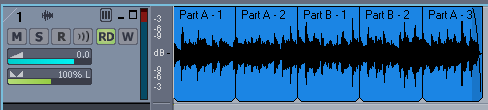
The riff has two repeating sections. I’ve labeled them “part A” and “part B,” and each repeats once.
Remember that the stereo effect arises in hard-panned, double-tracked songs because our ears hear two separate guitars playing. Since this track has repeated sections, I can create the illusion of two guitars playing by pairing different repeats of each section. I did that as follows:
- Duplicate the mono track.
- Split the second track into its repeating parts.
- Shuffle the split sections, so that parts A1 and B1 in the first track are paired with parts A2 and B2 in the second, and vice versa.
- Pan the tracks hard left and right.
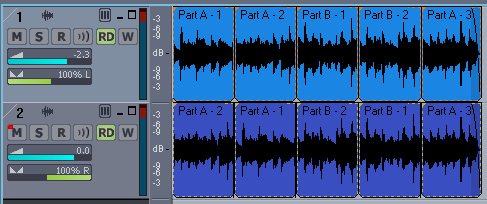
Now the two tracks each play the same part (A or B) at the same time, but a different “take” of each part. Here’s how it sounds:
A great stereo spread from a single mono recording!
Note that I left the last section (labeled “part A-3”) the same in both channels so you can clearly hear the difference between the “stereo-ified” version of the track, and the mono that results when both channels play the same thing. And for contrast, I mixed a “fake stereo” version created by duplicating and hard-panning the track, and delaying the left side by 5ms:
While this initially sounds like a stereo recording, your ears should quickly sense the overriding similarity in the left and right channels. The stereo effect collapses, especially after repeated listens. Contrast this with the doubled version above which sounds wide and dynamic no matter how many times you hear it!
For more home recording tips,
Subscribe to the Hometracked feed, or receive email updates.
20 comments
Trackback URI Comments feed for this article
Never thought about the shuffling sections part! Thanks!! Great post!
I have a couple things I might add to the article (which is great, thanks!)
My first thought is, be really careful where you cut and paste. Some instruments aren’t cut and pastable without obvious sound of the instrument being cut and pasted. An example would be drums, cymbals particularly, and overhead drum mics; you can cut them, I admit it, I’ve done it more than once! But it’s best to be very careful about where you cut so that the performance will still sound natural. I’ve messed it up many times, actually I don’t think I’ve ever done it and not found the cut noticeable, esp. if you know it’s there.
My other thought is that one can still fatten the tone by copying a track, panning it the other way, and putting some different EQ on it, then mixing that copy down low. Sometimes I find that I’ll pan the main track at 2 o’clock and the double at 8 o’clock (almost all the way left). And then slowly bring the double up until the image of that guitar is almost in the middle but still leaning towards 1 o’clock or so, altogether. But really, I don’t bother doing this that often because like Des said, it’s not real stereo, but it might thicken an existing tone up a little or provide a bit of push and pull over to the left because of the EQ change on that side.
But copying a track like I was just saying, and doing all that, plus moving it forward or backward by a 0-20 milliseconds or so, I personally avoid it, because I used to do it all the time. It’s got it’s own sound, maybe it’d come in handy for something someday, but I’m not a fan of it. When I go back and listen to tracks that were done that way, I never like it, I always wish I hadn’t thrown that double in there, off-time and all phasey sounding. Then again, that weird organ part that only comes in on the prechorus…hmmm
This made an acoustic recording I did on Monday sound about 600 times better. Thanks.
That’s great Bob, glad it worked for you.
> I’ve messed it up many times, actually I don’t think I’ve ever done it
> and not found the cut noticeable, esp. if you know it’s there.
Ya, I know what you mean. I’ve also found, though, that the effect is minimal when you cut like this for double-tracking, because details that stand out on one track by itself tend to be masked when you blend in the second track.
I’ve also found that playing with the end-points of the clips a little can add transparency. Like, on track 1 I’ll slide the clip overlap left a few ms, and on track 2 move it right a few ms. That way the edit points no longer line up exactly between tracks, which can further help hide the sound of the edit.
Wow, it does sound fuller and richer. But I guess this will definitely be time consuming for longer songs huh?
Kay, it totally depends on the material. Sometimes you can grab a whole verse as one section, and it takes no time at all.
And in general, even with more varied material, I find it takes no more time than, say, vocal comp’ing.
This is a great article, Des. I think most people, once they get into editing like this, will pick it up pretty quickly. It does take a critical ear to mix and match the right sections, though.
I used to think tracks had to be preserved, and takes recorded end-to-end, etc. Now I consider the recording/production process as an equal to songwriting and performing. Go to an open mike to get your ya-yas out playing end-to-end. In the studio, pick up the scissors and cut, baby! These kinds of techniques can truly transform your recordings. And when a listener hears something special, does he really care whether you “cheated”? I think not. Go ask George Martin.
> It does take a critical ear to mix and match the right sections, though.
Not to mention the importance of the material itself. I find it’s much easier to fatten a distorted electric guitar part this way than a clean acoustic guitar, since the transients are more obvious in the latter case, which means you need to be careful how the parts line up.
> I used to think tracks had to be preserved
I hear ya. I think that mindset is still appropriate for certain styles of music – certainly anything with a “live” feel, like jazz and chamber music. But the studio-as-instrument approach to music has its place too, no question.
Honestly I don’t even know what’s vocal comp’ing… is that ‘compressing’?
:P
Kay,
Comp’ing is short for Compositiong
Basically, it’s the process of building a single vocal (or instrumental) track from a collection of parts recorded in different takes. Electronic Musician details it far better than I could: http://emusician.com/special_report/art_vocal_comping/
just record a second guitar you lazy nerdz
I just stumbled across this article, and I wanted to say that for distorted electric guitar at least, this totally works and totally rocks.
I propose that this technique should be referred to as “desheading”.
Yes, I concur :-)
Honestly I don’t even know what’s vocal comp’ing… is that ‘compressing’?
Radyo, there’s a link 5 comment up from this one that explains it in more detail.
Doubling a mono and delaying one by 5ms will cause severe phasing and flanging issues, why would you do that? 10ms at least.
This is how i record acoustic guitar…I only use one mic and an acoustic/electric pickup. On the mic I use a stereo spreader on the frequencies between 1000 and 15000Hz at the highest possible …it leaves the bass notes intact in the center where they shoul dbe and spreads the harmonics out in a stereo image, I haven’t had real bad phase problems yet and it sounds sweet.
http://www.youtube.com/watch?v=T9PoLAKy6YA
A classic fake stereo-image technique is to double a mono (or stereo, if you hard pan a stereo track it effectively becomes a mono track), and then either :
– Add a delay effect on one of the track
Or
– Apply a manual delay by moving one the track a few milliseconds away from the other
This will put delay on the part – which you might want or not -, but the effect is like a huge stereo spread, almost surround in fact! Really impressive. It’s like the delay bounce for one side to the other creating a really massive stereo field *illusion (since you are in fact listened to two hard panned tracks, which are mono, whether they started as stereo or not).
Actually use this even doubling tracks recorded in stereo sometimes; if I still think the result is too “narrow” of flat.
You may wish to check out my website, monotoSTEREO.info (https://www.monotostereo.info), which provides a collection of resources for individuals interested in upmixing older mono source material to stereo through the use of spectral editing, sound source separation, and related processes. I am not referring to techniques which create a semblance of stereo… I am talking about stereo which sounds like it had been mixed from multitrack session tapes, had they existed! The website is about to celebrate its third anniversary and has been visited by individuals in 125 countries so far! Be sure to check out the many examples on the MEDIA pages of the website! There are over 1,100 links to research papers, presentations, etc. in the field on the RESEARCH pages of the website. There is also a companion Facebook page (https://www.facebook.com/monotostereo.info) for the website where I post updates and related content. I hope that you find the website interesting, informative, and thought provoking!
Great technique! I often use this or simply shifting the duplicated track 5-30ms to create wider guitars and pads.